Google isn't the only way customers find you anymore. Here's what AI-driven search means for your store, and what you need to do about it now before your competitors do.
For about a decade, e-commerce SEO was a predictable game. Optimise your product pages, build some backlinks, earn some category authority, watch the traffic come in. Google rewarded effort applied consistently over time.
That game hasn't ended. But a new one has started alongside it – and most e-commerce brands haven't noticed yet.
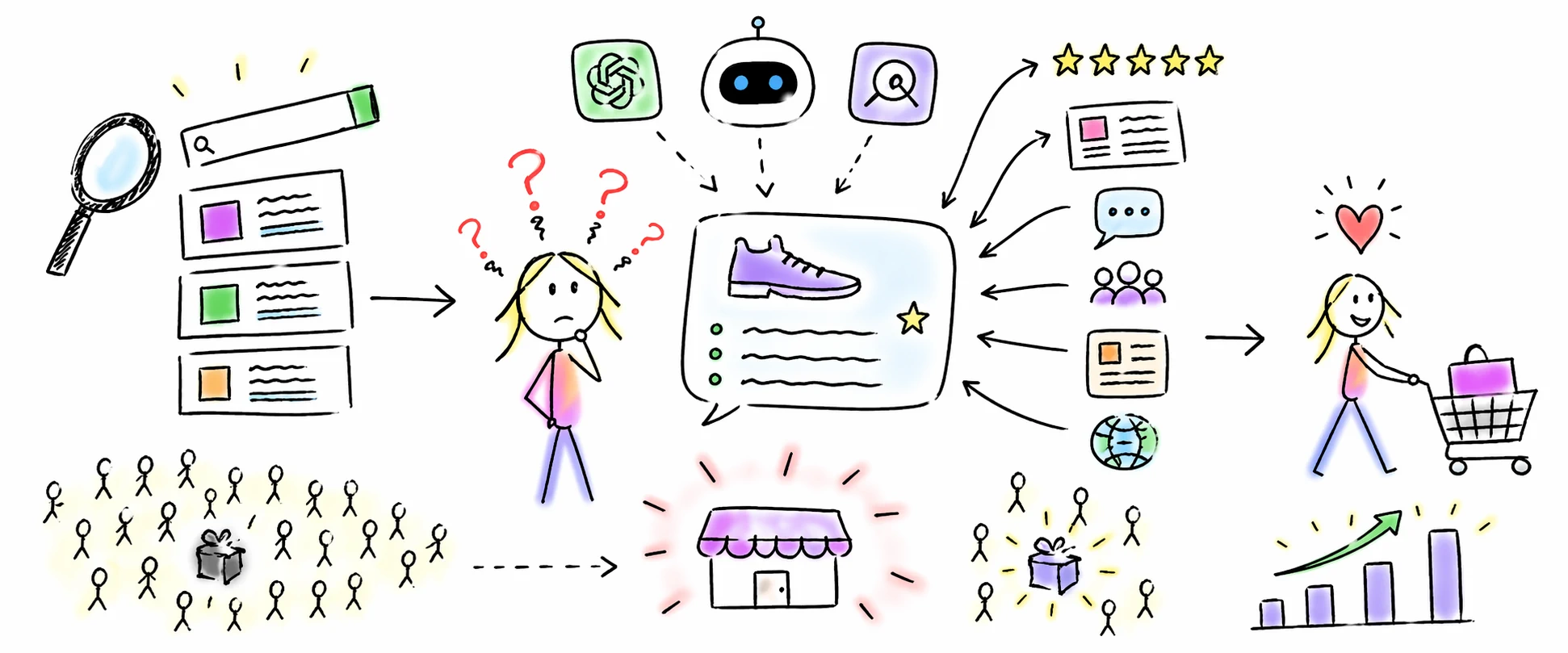
An increasing share of product discovery now starts not with a Google search, but with a question asked to an AI assistant. ChatGPT. Perplexity. Google's own AI Overviews. The consumer behaviour is different: instead of 'best running shoes for flat feet,' it's 'I've been having knee pain on runs, what should I look for in a shoe and what are some brands that are known for this?'
The response they get isn't a list of ten blue links. It's a synthesised answer that may or may not mention your brand – and the criteria for inclusion aren't the same as traditional SEO.
This matters because the customer who arrives at your store via an AI recommendation is already partially sold. They've been told you're relevant. Your conversion rate from this traffic is higher. And yet most brands are doing nothing to earn these mentions.
Traditional SEO is about signals: backlinks, keyword density, structured data, domain authority. These still matter. But AI-driven visibility draws on a different set of inputs.
Entityclarity: AI systems need to understand unambiguously what you are, what you make, and who it's for. Brands with vague positioning fare poorly. If your own website can't clearly answer 'what problem does this brand solve and for whom,' an AI won't be able to either.
Third-party corroboration: AI systems synthesise from multiple sources. Reviews, press mentions, editorial coverage, comparison articles, forum discussions – if your brand shows up consistently in these contexts, it gets included in answers. If it only shows up on your own site, it doesn't.
Specificity of claims: broad claims ('high quality,' 'premium') don't help. Specific, verifiable attributes do – materials, certifications, use cases, measurable outcomes. These are the things that get pulled into AI-generated summaries.
Audit your product descriptions for specificity. Replace vague language with precise, verifiable detail. Not 'made with quality materials' but 'constructed from 14-gauge 316 stainless steel, rated for outdoor exposure.'
Build third-party presence actively. Earn reviews on independent platforms. Pursue editorial placements. Contribute to round-up articles and comparison content. The goal is to exist in multiple credible contexts beyond your own site.
Clarify your positioning everywhere. Your about page, your category descriptions, your FAQ – all of it should make your brand's specific positioning crystal clear. Ambiguity is an AI visibility penalty.
Test AI search directly. Ask AI assistants questions your customers would ask. See if your brand appears. See who does. This tells you what the gap looks like and where to focus.
In early 2026, most e-commerce brands are not optimising for AI-driven discoverability. That's an advantage for the ones who start now. The brands that establish strong AI visibility in the next 12 months will have a compounding edge by the time this becomes common practice.
This is not a prediction about the future. It's a description of what's already happening. The question is whether you're going to show up in those answers or not.


.svg)