Linda Saunders from Salesforce argued in TechFinancials this week that retailers now need to win the trust of AI agents as well as shoppers. She's right, and the numbers support her. Salesforce's latest State of Commerce report found that consumer reliance on AI assistants as the first stop for shopping tripled year on year, while traditional search traffic to brand-owned channels dropped 15%.
Linda Saunders from Salesforce argued in TechFinancials this week that retailers now need to win the trust of AI agents as well as shoppers. She's right, and the numbers support her. Salesforce's latest State of Commerce report found that consumer reliance on AI assistants as the first stop for shopping tripled year on year, while traditional search traffic to brand-owned channels dropped 15%. On Shopify's own platform, AI-driven traffic to stores grew eightfold year on year in Q1 2026, and orders from AI-powered searches rose almost thirteenfold.
What I want to add is the South African timing, and what "ready" means for a merchant who isn't running an enterprise data platform.
Where South Africa actually stands
Right now, purchasing inside AI channels is only available to US buyers. A South African store selling to South African customers can still be found and recommended by an AI assistant, but the agent isn't completing the purchase for your customer yet. Shopify says its merchants will be switched on automatically once AI partners expand to more regions.
"Ready by default" is the phrase I'd be careful with. Shopify will switch the channel on for you. It won't fix your product data, your stock sync or your delivery promises. That part is yours, and it's the part that decides whether an agent recommends you.
Agents don't see your campaign
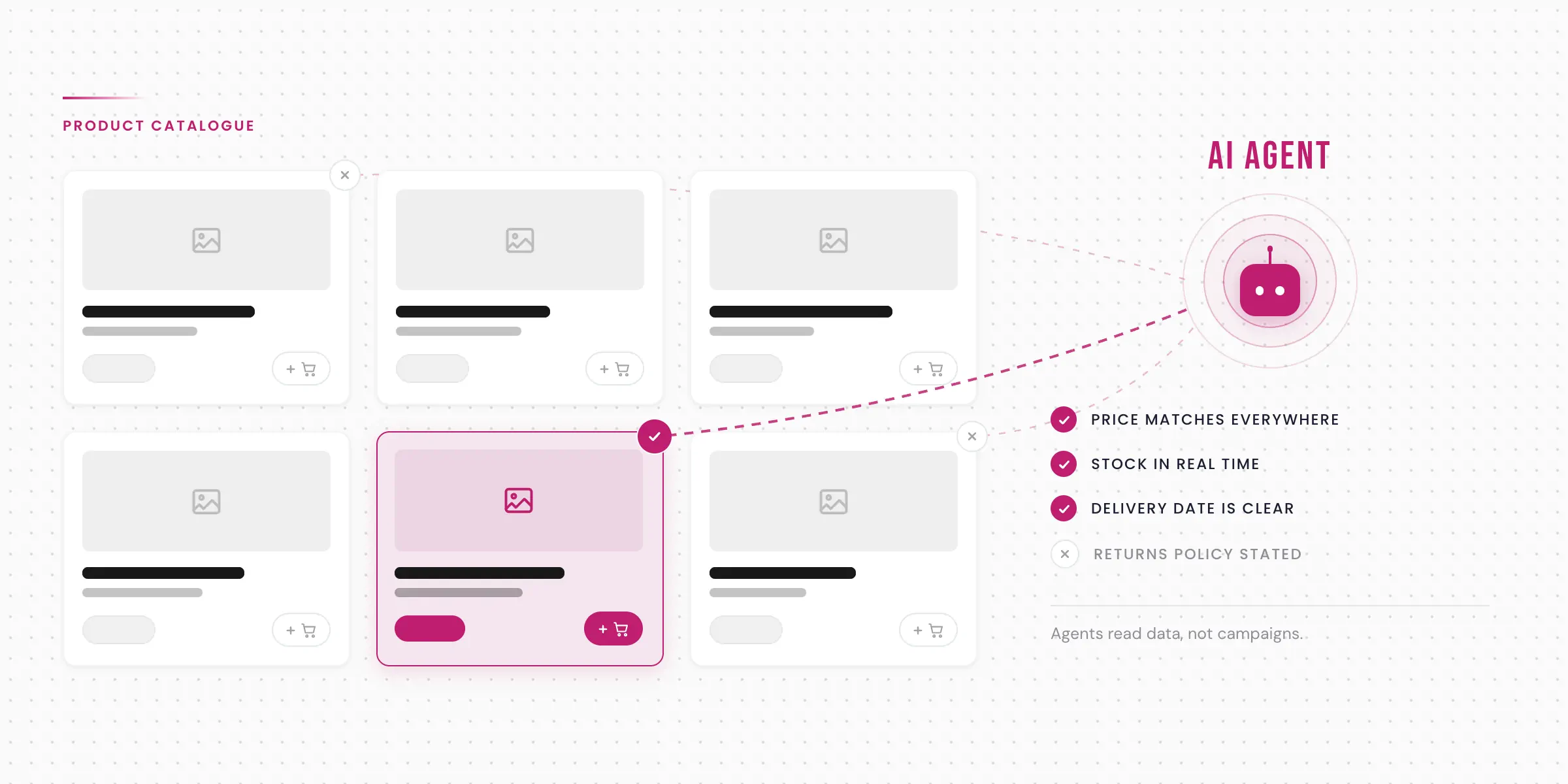
An AI agent doesn't watch your launch reel or notice your homepage banner. It reads your catalogue: titles, descriptions, variants, prices, stock levels, shipping rules and policies. Then it decides whether you're a safe answer.
Picture a shopper asking an assistant for a king-size linen duvet cover under R2,500, delivered to Pretoria before Saturday. If the size only appears in a product photo, if your Takealot price doesn't match your site, or if your delivery page says 3 to 7 working days with no cut-off, you're eliminated before a human ever sees your brand.
We've already seen what happens when the operational layer isn't there. OpenAI shut down Instant Checkout in March 2026 after fewer than 15 merchants went live, reportedly because it lacked the systems for sales tax, fraud prevention and real-time inventory sync at scale. The idea didn't fail. The plumbing did. The same test applies to every merchant who wants to be recommended.
Consistency is what gets you recommended twice
Salesforce's research shows how common the plumbing problem is. Among businesses with fragmented data, 41% report inconsistent pricing and promotions, and 40% say their inventory isn't synchronised in real time. In a normal online journey, a wrong price costs you one sale and an irritated customer. In an agent-led journey the cost compounds: the retailer takes the reputational hit, and the agent quietly learns to stop recommending them.
The failure points I see most often in South African stores are ordinary ones. Stock tracked in a spreadsheet alongside Shopify. Different prices on the website, the marketplace and in store. Sale prices that don't switch off on time. Courier cut-offs that shift in December without the site being updated. A returns policy nobody can find.
None of this is new. Agents just remove the human who used to forgive it.
What ready looks like
Write product data for questions, not keywords. Materials, dimensions, sizing, compatibility, care instructions and who the product suits, in structured fields and plain text rather than baked into images.
Run one source of truth for price and stock. If you sell on your site, a marketplace and in a physical store, those numbers have to agree in real time, not after Friday's stock take.
Make your policies complete and specific. Shipping zones, delivery timelines, cut-offs and returns should be clearly stated on the store. Complete store policies are already a prerequisite for Shopify's agentic storefronts.
Build it as a system, not a clean-up project. A one-off catalogue fix decays the moment a new range goes live. Document how products are added, which fields are mandatory and who checks them, so data quality doesn't depend on who happened to upload that week.
Nobody will announce the start
When checkout inside AI assistants opens to South African buyers, there won't be a six-month countdown. The stores that get recommended in the first weeks will be the ones that fixed their data while it still felt optional.
I've been building ecommerce in South Africa since 2009, and every major shift has rewarded the merchants who did the unglamorous operational work early. This one will be no different.
If you want to know how your store would hold up when an agent comes looking, talk to us at Maverick.
Melissa Rowlston is the founder and lead ecommerce strategist at Maverick Marketing & Web, a Shopify-specialist agency in Johannesburg.


.svg)